Yes or No Wheel: A Guide to Faster Decisions
We live in an era of unprecedented choice. From choosing between fifty streaming shows to deciding whether to attend a social gathering or tackle a difficult work task, human brains are constantly bombarded with minor forks in the road. When the cost of deciding exceeds the value of the decision itself, a Yes or No wheel is the ultimate antidote to analysis paralysis.
1. The Hidden Tax of Analysis Paralysis
In psychologist Barry Schwartz's seminal work The Paradox of Choice, research demonstrates that an abundance of options leads not to liberation, but to anxiety, second-guessing, and cognitive exhaustion. When we agonize over trivial choices—such as whether to order take-out, go to the gym at 6:00 AM, or clean out our inbox—we drain cognitive glucose that should be preserved for high-leverage creative thinking.
A dedicated Yes or No wheel strips away the noise. It collapses infinite rumination into a binary fork, restoring action and forward momentum in under three seconds.
2. The Freud Coin-Flip Trick: Unmasking Your Gut
Legend holds that Sigmund Freud frequently advised patients stuck between two difficult paths to flip a coin. The magic was not that the coin made the decision for them; rather, it was what happened in the split second the coin was suspended in the air.
"While the wheel is spinning and slowly clicking down to its final segment, your logical defenses drop. If the pointer settles on 'No' and your immediate visceral reaction is a pang of regret, your subconscious mind has already decided: you wanted 'Yes'."
In this way, our random decision wheel is not an surrender of agency—it is a diagnostic mirror that reveals your authentic preference before conscious rationalization can muddy the waters.
3. 5 High-Impact Use Cases for a Yes/No Wheel
A. Overcoming Procrastination on Daily Micro-Tasks
Staring at a task you’ve avoided all week? Ask the wheel: "Do I start the first draft right now?" If it lands on Yes, commit to a strict 15-minute sprint. Once you cross the starting line, momentum takes care of the rest.
B. Eliminating Social Stalemate
Friends arguing over whether to stay out for another drink, order dessert, or head home? Put the collective vote to the wheel. Because everyone witnesses the physical animation decelerating, groups accept the outcome with zero resentment.
C. Classroom Check-Ins & Quick Formative Feedback
Teachers use the Yes/No preset on smart boards for rapid-fire review questions: "Is 17 a prime number?" "Did the protagonist make this choice willingly?" Students point or show thumbs, followed by a live spin to verify. See our classroom name picker for full roster integration.
D. Creative Writing Prompts & Story Turning Points
Novelists and tabletop roleplayers often encounter writer's block: "Does the guard notice the character sneaking past?" "Does the potion work as intended?" A quick spin introduces authentic emergent narrative twists.
E. Household Chore Delegation
"Do we tackle the garage organization this Saturday morning?" If the wheel says No, permission to rest is granted guilt-free until next weekend.
4. The Mathematics of a Digital Yes/No Spin
Unlike physical coins, which can be subtly biased by manufacturing tolerances, thumb flick angles, or table bounce physics, swheel.us uses the browser's native crypto.getRandomValues() algorithm. This cryptographically secure pseudo-random number generator (CSPRNG) produces uniformly distributed entropy, guaranteeing that over any sequence of spins, the probability distribution remains asymptotically 50.000% Yes and 50.000% No.
5. When to Spin vs. When to Deliberate
The 10/10/10 Rule for Random Decisions:
Ask yourself: Will this decision matter in 10 minutes? In 10 months? In 10 years?
- If it won't matter in 10 months: Spin the wheel immediately and take action.
- If it will fundamentally alter the next 10 years: Close the browser, gather data, consult mentors, and deliberate carefully.
Is a Yes or No wheel truly 50/50 fair?
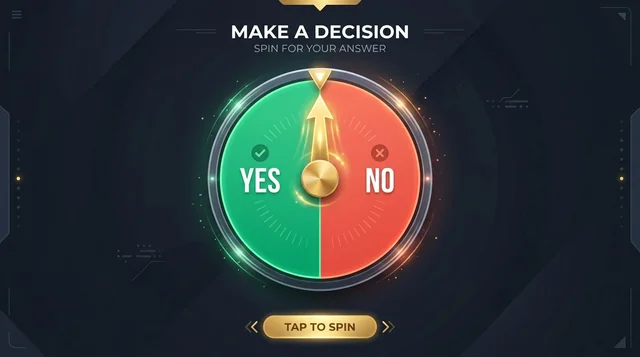
Yes. On swheel's Yes or No wheel, both segments occupy exactly 180 degrees of the circle. The spin uses browser-native cryptographic pseudo-random number generation (PRNG), ensuring unbiased, mathematically equal 50% odds on every spin.
How does spinning a wheel help me know what I really want?
Psychologists call this the 'coin-toss revelation'. While the wheel is decelerating, your subconscious anticipates a specific outcome. If the wheel lands on 'No' and your immediate gut reaction is disappointment, you instantly know your true preference was 'Yes'.
Can I add weights or a 'Maybe' option to the Yes or No wheel?
Yes! In our custom wheel editor, you can add 'Maybe', 'Try Tomorrow', or weight an option by typing Yes [2x] to double its probability. Our pre-built templates also offer 3-way and 4-way decision options.
When should I NOT use a Yes or No wheel?
Avoid random decision wheels for high-consequence life choices, financial investments, legal commitments, or medical decisions that require deliberate risk analysis. Reserve the wheel for low-to-medium consequence choices where speed and momentum matter most.